site title

HOME PROTECTION NATURE PLAN YOUR VISIT FAQ JOIN/DONATE ABOUT

Broadleaf Trees in Douglas-Fir National Monument

This section features some, but not all, of the broadleaf trees in the proposed Monument.

acer macrophyllum 1 graphic

Photo: Oregon State University

acer macrophyllum 2 graphic

Photo: acma/Oregon State University

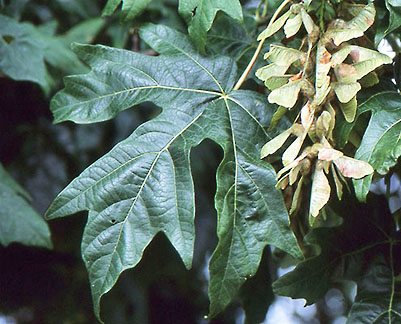
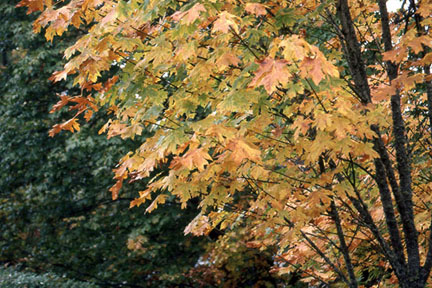
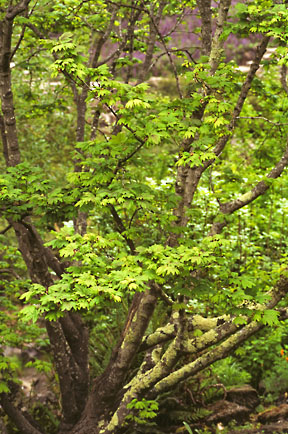
Bigleaf maple, or Oregon maple, Acer macrophyllum
Largest of the maple trees; the current national champion, in Lane County, OR, is 119' tall.  The palmate and deeply lobed leaves are also the largest of any maple, turning bright yellow in the fall.  Bark of mature trees is deeply furrowed and often covered by mosses, liverworts, ferns and lichens.  Used by many species of wildlife.  The wood was used by Native Americans, and is currently employed for furniture and musical instruments; the sweet sap can be boiled down into syrup.


acer circinatum 1 graphic

acer circinatum 2 graphic

Photo: Oregon State University

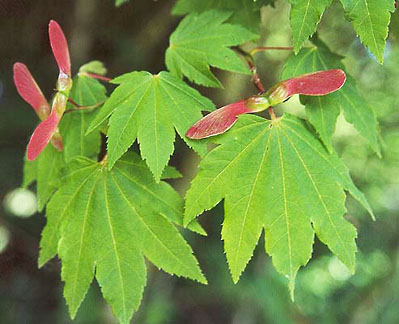
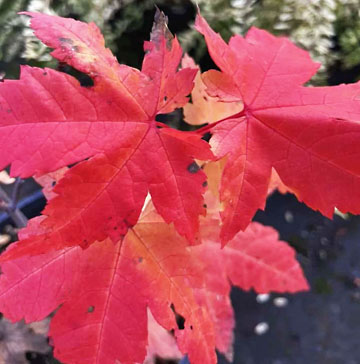
Vine maple, Acer circinatum
A low-elevation tree of moist forests, usually small and shrub-like (but can grow to over 25 feet) with many branches.  The leaves are opposite, and palmately lobed with the points forming a circle, turning brilliant red in the fall, or more yellow when in the shade.  Vine maple grows by cloning, and can thrive after a disturbance.  The wood was used by Native Americans for tools and its thin branches for weaving.  The leaves are browsed by deer and elk; flowers, buds and seeds are eaten by small mammals and birds; insects, including bees, use the tree as well.


acer glabrum 1 graphic

Photo: Stan Shebs Creative Commons

acer glabrum 2 graphic

Photo: xeraplants

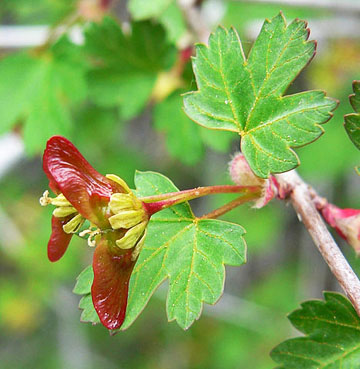
Douglas maple, or Rocky Mountain maple, Acer glabrum
A small, multi-stemmed tree, usually 20'-30', typically with opposite, smooth, three-lobed leaves that turn yellow to orange in the fall, and reddish winged seeds.  Found along streambanks and often in disturbed areas.  The strong stems were used by native peoples for bows and snowshoes.


populus trichocarpa 1 graphic

Photo: Hans/Pixabay

populus trichocarpa 2 graphic

Photo: Hans_tribe/Pixabay

populus trichocarpa 3 graphic

Photo: Potri/Oregon State University

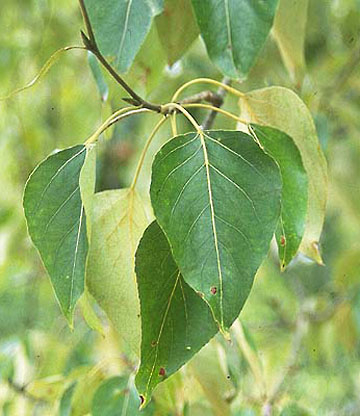
Black cottonwood, Populus trichocarpa (formerly in the genus Frangula)
A fast-growing and large tree; the current record-holder, near Salem, OR, is 155' tall and 29' in circumfrance.  Leaves are alternate and elliptical with a crenated margin; flowers are yellow.  The seeds carry cottony fluff that is released into the air in spring.  The wood is brittle and very hard. Black cottonwood often grows on wet soils near streams. It was recently discovered that the tree can fix atmospheric nitrogen.


frangula purshiana 1 graphic

Photo: Native Plants of the PNW

frangula purshiana 2 graphic

Photo: baumlyriker/Pixabay

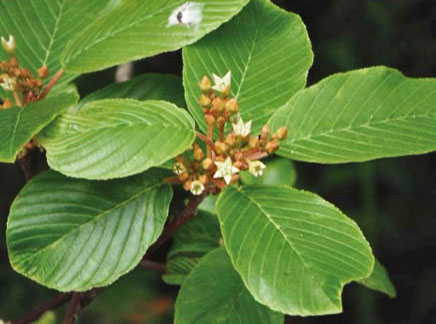
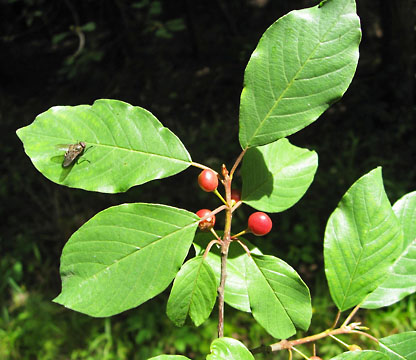
Cascara buckthorn, Frangula purshiana
A large shrub or small tree up to 50' tall.  The bark is brown to gray, and the inner bark is notable for being intensely bitter, even numbing the taste buds.  The leaves are simple, alternate, turning yellow in the fall.  Flowers are tiny, greenish-yellow, and the fruits are red becoming dark purple to black.  The dried bark, called "chittum bark" was used as a laxative by native peoples and is still collected for that purpose.  Loved by a variety of birds and butterflies.


castanopsis chrysophylla 1 graphic

Photo: Plants of the PNW

castanopsis chrysophylla 2 graphic

Photo: Bressette/Plants of the PNW

castanopsis chrysophylla 3 graphic

Photo: Bressette/Plants of the PNW

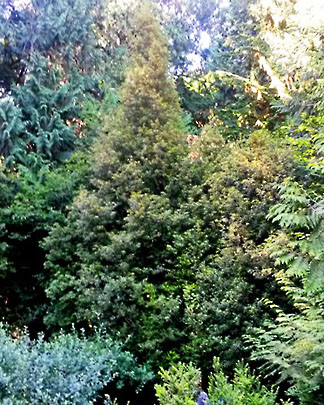
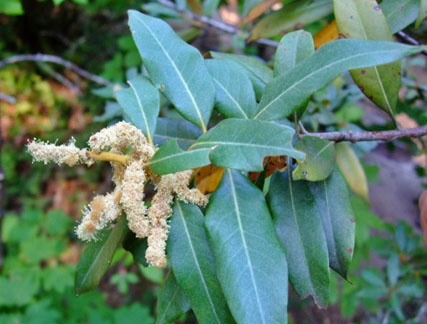
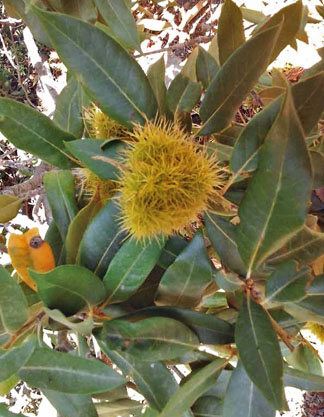
Golden giant chinquapin, or giant chinquapin, Castanopsis chrysophylla
Chinquapin grows as a shrub in hot and dry locations, but becomes a tree up to 148' tall in cool, moist areas.  The species is related to chestnuts, and can live as long as 500 years.  Leaves are lance-shaped, evergreen and leathery, with golden scales on the undersides.  A cluster of nuts in a spiny burr is produced in the fall; the nuts were roasted and eaten by native peoples.  The tree is the only known host of the Golden Streak butterfly.


quercus garryana 1 graphic

Photo: quga/Oregon State University

quercus garryana 2 graphic

Photo: Hans/Pixabay

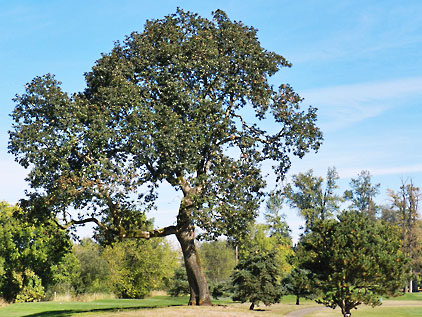
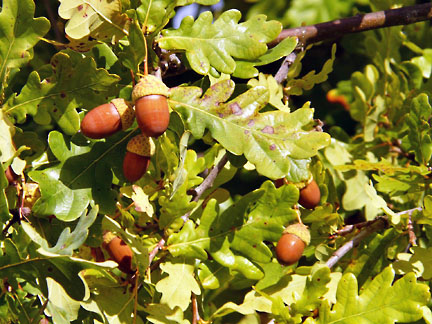
Oregon white Oak or Garry oak, Quercus garryana
Can be a large shrub or a tree as tall as 100' with deciduous, alternate leaves.  In Oregon, the tree is found mainly on the west side of the Cascades, and often has mistletoe, and/or galls produced by wasps.  Native americans ate the acorns, as do bears and other wildlife.  The dense wood has been used for fenceposts and furniture, and makes excellent firewood.


cornus nuttallii 1 graphic

Photo: Sylvia Sharnoff

cornus nuttallii 4 graphic

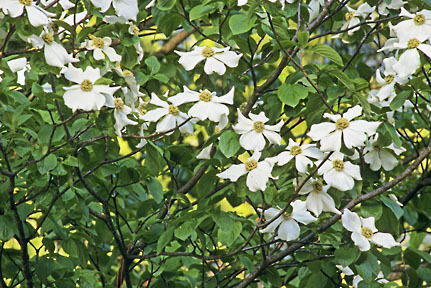
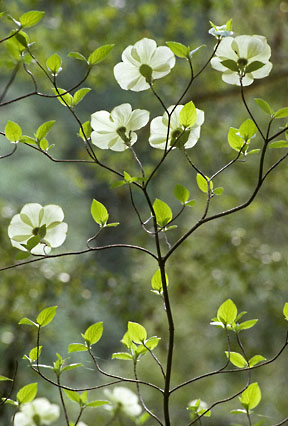
Pacific dogwood or western dogwood (Cornus nuttallii)
A beautiful, small or medium-sized multi-branced deciduous tree, reaching to about 70' and often growing along streambanks.  The leaves are simple, oval, and opposite.  The flowers are conspicuous with large white "petals" (actually bracts), while the flowers themselves are tiny and clustered in the center.  Dogwood often blooms twice each year.  It is used as habitat for the red tree vole and small birds, and the seeds are eaten by both birds and small mammals.  Native peoples used the bark for medicine and dye.


arbutus menziesii 1 graphic

arbutus menziesii 2 graphic

arbutus menziesii 3 graphic

Photo: armen/Oregon State University

arbutus menziesii 4 graphic

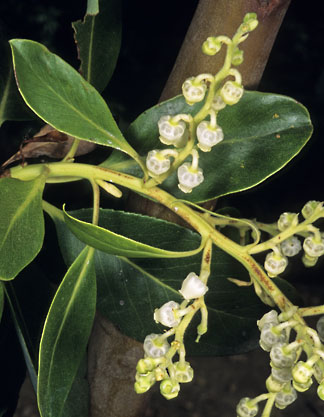
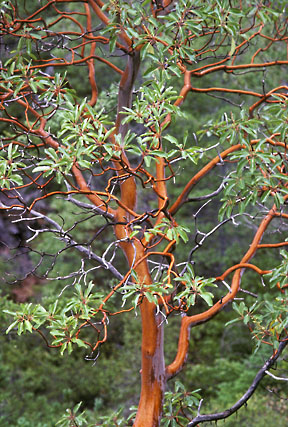
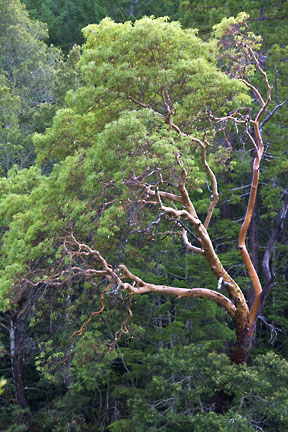
Pacific madrone, Arbutus menziesii
A striking evergreen tree with flaky, bright red-orange bark  that leaves a shiny smooth surface when it peels.  The tree can reach almost 100' in height, but is usually smaller.  Leaves are glossy dark green, alternate, simple and ovate.  The flowers are white, bell-shaped and small, and the berries are bright red-orange.  Madrone often grows alongside Douglas-fir.  Many kinds of birds eat the berries and also use the tree for their nests.  Native peoples made tea from the bark.


alnus rubra 1 graphic

Photo: Sparrowhawk Native Plants

alnus rubra 2 graphic

Photo: armen/Oregon State University

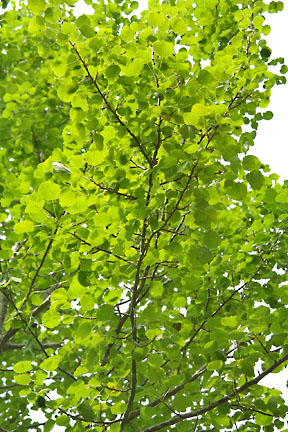
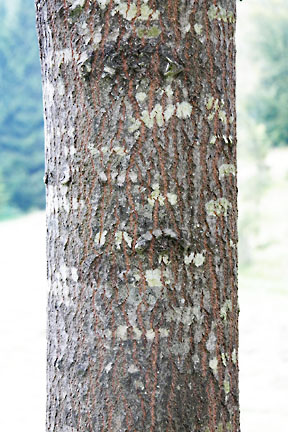
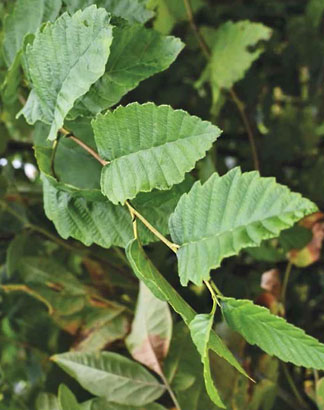
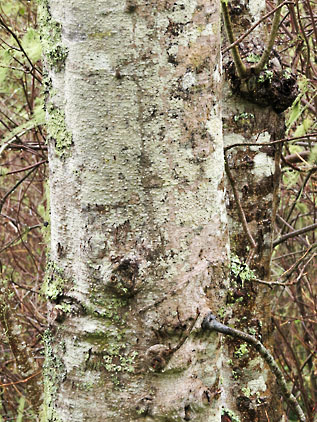
Red alder (Alnus rubra)
The largest species of alder, sometimes growing to almost 100'.  The trunks are smooth and gray, often covered with a mosaic of white and pale green lichens.  Leaves are ovate, with edges that curl under.  Flowers are dangling reddish catkins.  The tree prefers moist slopes, and it will rapidly colonize after a burn or a clearcut; its seeds have small wings and are produced in large numbers.  Deer and elk use the tree as browse and beaver eat the bark; birds eat the seeds.  Red alder hosts a bacterium on its roots that fixes atmospheric nitrogen, making it an important contribution to soil fertility. At higher elevations a related species, Sitka alder (Alnus viridis subsp. sinuata) replaces Alnus rubra.


Return to Nature